Sunday, January 5, 2014

"Terms of Endearment"

"Wayne Weinsider. He's a Czech national. Emigrated in 1994. He's also known as Bud Hasselhoff. Also known as Gordy Boytano."
Originally Aired 1/3/99


Similar to remembering to write dates on your check with the new year, I had to remember that this episode had aired in 1999. It's hard to believe that it's "1999" already, with only 3 years left on this journey through the series. At least I'm back in familiar territory now following a few weeks of high concept episodes, which featured ghosts and body swapping hijinx. I've watched "Terms of Endearment" once before, and though I recall Bruce Campbell in the lead guest starring role, that was back in 2007.


Bruce Campbell gives a fine performance as Wayne Weinsider, who's like most parents, in that he wants a normal, healthy baby. It just turns out that he's not a normal parent; he's a really a demon. It was a wise choice to have him portray a loving husband than your typical over-the-top demon, which is also opposite of many humorous characters he's known for in the Evil Dead series and The Adventures Brisco County, Jr.; that series coincidentally premiered on the same night as The X-Files back in 1993. While Bruce Campbell, David Duchovny, and even Chris Owens in his brief scene, are fun to watch, I think the problem with "Terms of Endearment" is it's tone. It's credited to a new writer to the series, David Amann, who also happens to provide the first script of the season from a non-regular writer/producer. The previous six episodes have been from the usual suspects- Chris Carter, Vince Gilligan, John Shiban, and Frank Spotnitz. If you look back further into Season Five, the last few were also penned by them as well. Perhaps David Amann had big shoes to fill, stepping in as a new writer during The X-Files at it's peak.

"Terms of Endearment" begins as an episode that would feel at home in the earlier seasons, with a deformed infant and a nightmarish sequence with a demon, which is the kind of terrifying standalone that we haven't seen in some time. The episode reveals itself later on to be a dark comedy, with Wayne actually being a demon with multiple wives so that he can finally father a normal child. It seems to shift back to being a terrifying episode when Wayne attempts to kill one of those wives. It's as if each act shifts from one tone to the other. Despite that, there are several moments here to enjoy and I really appreciate the dark scenes around the Weinsider's creepy house. Even with the California setting, the series is still creating fine visuals so that the transition between locations isn't even noticeable. The special effects used to create the demon are effective and I like the use of what looks to be prosthetic make-up, which actually looks better than some monsters I've seen created on a movie's budget.


Any episode where a guy has an alias of "Gordy Boytano" is a welcome addition to the series. "Terms of Endearment" is worthy of it's place in the series, and though I said the frightening demon may have felt at home in an earlier season, the episode as a whole could only have worked in this season. It's just more proof how far this series has expanded it's scope and is continuing to do so.

Monday, December 16, 2013

"How The Ghosts Stole Christmas"

"What's waiting for us? More loneliness! And then 365 more shopping days till even more loneliness!"
Originally Aired 12/13/98

Don't give this man a gun or he'll make googly eyes.
With so many high concept episodes in a row, there had to be one that was a miss, and unfortunately it's "How The Ghosts Stole Christmas." However I don't think it's a waste of an hour of The X-Files. Other than the season premiere, this season has been about stretching outside of the series' formula, so I appreciate the effort. "How The Ghosts Stole Christmas" has several concepts- first, its a "bottle" episode, which is an episode that utilizes minimal sets. In this case, Mulder convinces Scully to investigate a haunted house with him. Other than the opening and closing of the episode, it's mostly set in the house's large library. That brings us to concept number two, which is a Christmas episode, and also the second season in a row to feature this holiday.

Besides the minimal sets, there are also a minimal amount of actors; only David Duchovny, Gillian Anderson, and it's two guest stars, Lily Tomlin and Ed Asner. In order for the episode to work, it actually depended on the casting, and Tomlin and Asner make for a great pair of spooks. Instead of the typical ghostly activities like rattling chains, walking through walls, and levitating objects, these two ghosts actually try to get under the skin of Mulder and Scully by using psychology. It's another way for the writers to examine the relationship of Mulder and Scully, as the ghosts separate the two so they can turn the agents against each other. That's where the episode fails; well, partly fails. The dialogue from Chris Carter seems overly wordy and long-winded, but maybe that's the point, since the ghosts bicker over their methods of haunting their guests. I felt the best part is not Mulder and Scully being tormented by ghosts, rather it's an unseen participant in this episode, the music of Mark Snow. This is by far his best work, which reminds me of classic horror movies that would feature the Wolf-Man or the Invisible Man, while also being as light as the comedy within the episode.

The ghosts accusing Mulder of being lonely actually shows continuity between this season's standalone episodes. Last week, when Mulder was inside the body of Morris Fletcher and separated from Scully, he wasn't just fighting to get back to his body, but also Agent Scully. We already know his whole life is investigating X-Files cases which has now been taken away from him from the FBI, so all he has is convincing her to join him on stake outs and wild trips to Area 51. Scully isn't going anywhere though, since shes had numerous opportunities to leave yet remains by his side, so Mulder has nothing to fear. How many people would show up at their co-worker's door after midnight on a holiday?


Saturday, December 7, 2013

"Dreamland II"

"Hey, Grandma Top Gun, will you please shut the hell up!"
Originally Aired 12/6/98


If last week's episode was "Small Potatoes" turned up to 11, this episode plays like a combination of "Jose Chung's 'From Outer Space'" and "Musings of a Cigarette Smoking Man" yet feels like an original creation on its own. I felt like "Dreamland II" is a showcase for the comedic talents of Michael McKean as it pokes fun at his character of Morris Fletcher, a "Man in Black" stationed at Area 51, or even many of the Men in Black featured throughout the years on this series. Its even more obvious when you consider his line to Scully after his failed seduction, "You think being a 'Man in Black' is all voodoo mind control? You should see the paperwork." Not only does Morris Fletcher fail at seducing Scully, he also has a hilarious encounter with the Lone Gunmen, and he seems intent to stay in his new "life" as Fox Mulder. The scene with Morris insulting the Gunmen by telling them their publication just prints phony conspiracies that he came up with while on the toliet is hilarious, especially his revelation that Saddam Hussein is just an actor hired by our government. Its just like a twist seen in the recent Iron Man sequel.


Meanwhile, David Duchovny as Mulder, still in the body of Morris Fletcher, plays the role of straight man for most of this episode as he tries to undo the damage he's done to Morris' life and get back to his own. As Morris' portion of the episode pokes fun at the Men in Black, Mulder finally meets his mysterious informant and that revelation appeared to spoof all of the alien encounters we've seen on the series, even the scene in "Redux" when Kritschgau spills the beans of the military-industrial complex to Agent Mulder. Mulder's source just oversees test flights at Area 51, which is just a cover story for aliens, and he doesn't even know if they really exist. All of the pilots and military personnel we've seen over the years, dating back to "Deep Throat", probably are just like the General in this episode; they only know the role they're supposed to play and are nothing more than a cog in the giant, government wheel. So everyone is just a puppet of The Syndicate? Spooky.

With all of this going on over the course of "Dreamland I and II", it appears Scully could be left out of the fun but she isn't. Scully sees through Morris' seduction and has a wonderful scene later with Mulder where she tells him she'd kiss him if he wasn't so damn ugly. The highlight of the episode comes mid-way through, where we see Mulder and Joanne (Morris' wife) sharing a drink at a bar in the desert. The scene pans across the bar where the General is meeting with Mulder at a booth, who he doesn't realize is actually Morris Fletcher. Further complicating matters is that Scully is outside and Morris' coworker Jeff arrives as well, and this whole sequence plays out like scene straight out of a sitcom, or even a movie. It reminded me of some of the wacky contrivances on Frasier or Seinfeld in which the main characters are trying to sneak out of a tricky situation and go unnoticed, only for it to backfire on them. It's a brilliant scene by the writers at the peak of their powers, showcasing Gillian, David, and their amazing guest star Michael McKean. Bravo guys, and gals, "Dreamland II" is another excellent installment that truly shattered the"monster of the week" mold.

Thursday, December 5, 2013

"Dreamland"

“Ladies and gentlemen, Mr. Johnny Cash.”
Originally Aired 11/29/98


For as long as I have been a fan of The X-Files I have been very skeptical of the Sixth Season. This was the first year the series was filmed in sunny California, after the previous seasons were located in lush Vancouver. The change in location seemed to usher in a lighter tone for the series, with more of a focus on comedic episodes. On the heels of an intense Fifth Season and the feature film, this seemed like a bad move that could’ve cut short the mainstream success of the series. Last week’s “Triangle” was a fantasy episode taking inspiration from The Wizard of Oz, while “Dreamland” borrowed from Freaky Friday, and even earlier was the Speed-like episode titled “Drive.” All of these are not your typical hour of The X-Files.

Though “Dreamland” was amusing, as the episode moved along, I wondered why Mulder would so easily accept that he’s suddenly body-jumped into a Man in Black from Area 51. He doesn’t put up a fight or even call Scully until well after he’s inside of the Area 51 compound. I suppose this is no different than many conspiracy thrillers, which were much more enjoyable once you stop thinking and enjoy the ride. The point of this episode smacked me across the face when I remembered Scully’s conversation with Mulder from the beginning of the episode: “Don’t you ever just want to stop? Get out of the damn car? Settle down and live something approaching a normal life?” This is Mulder in that normal, suburban life, yet hilarity ensues when it clashes with his typical bachelor life of crashing on the sofa in front of adult movies. It’s like “Small Potatoes” turned up to 11, which coincidentally this episode co-stars Michael McKean of Spinal Tap fame. That’s actually a brilliant move on the part of the writers, which sees Vince Gilligan return to that concept from his earlier episode, and now includes the assistance of Frank Spotnitz and John Shiban. “Small Potatoes” featured David Duchovny portraying someone else in the guise of Fox Mulder, and this episode expands upon that concept with Michael McKean and Duchovny playing each other’s character.

The body swapping isn’t just limited to an FBI Agent and a Man in Black, but there’s also a man morphed with the floor of a gas station and a pilot who’s swapped with an elderly Native American woman. The best morphing is his co-pilot, who has become one with a large boulder. Despite all of these odd morphings, what I found funnier was that Morris Fletcher’s fellow Area 51 co-worker looked like a doppleganger of Agent Spender, who seemed to have an ulterior motive (guess I’ll find out for sure in Part 2.)

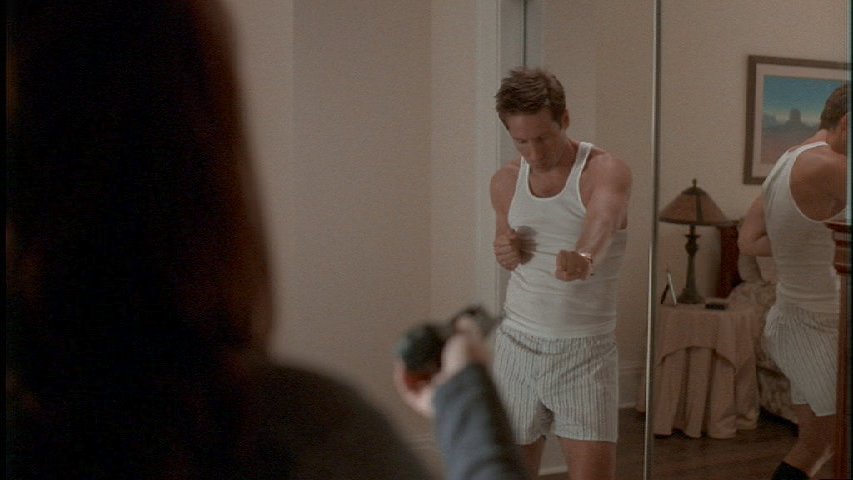
Hey! That's Mulder's reflection in the mirror, not Morris!
I can admit when I’m wrong about tv shows and movies, and boy, I was wrong about Season Six. This lighter turn for The X-Files is more than just about comedic episodes, it’s possibly the ballsiest move that I’ve witnessed from any television series! If Season Five was supposed to be the writers stretching the show’s format, they were still playing within the confines of the “case each week” mold. However Season Six has completely thrown that format out the window! Though “Drive” had Mulder discover the “X-File” via channel-surfing, these last two episodes haven’t had a case at all, or at the very least the thinnest hint of an investigation. An anonymous informant within Area 51 is just a MacGuffin in order for the body-swapping hijinx to begin; after that it’s purely a showcase for the comedic talents of David Duchovny and Michael McKean. I bet they didn’t even include anything in the script for the scene where McKean is playing Mulder’s reflection in the mirror, they just let those two actors loose to improvise their own routine. While “Dreamland” may not have made me laugh as much as previous episodes, this was certainly David Duchovny’s funniest performance and “Annoyed Scully” is always welcome.

Friday, November 22, 2013

"Triangle"

“I want you to do me a favor. It is not negotiable. Either you do it or I kill you. You understand?”
Originally Aired 11/22/98


I recently watched an episode of Mystery Science Theater 3000 which featured a movie about a caveman in a modern day world; no, it wasn’t Encino Man. A line used in that episode, which poked fun at a movie called Eegah, could easily sum up the events of “Triangle”; “we’re on a collision course with wackiness.” Much like Darin Morgan and Vince Gilligan have done before, this is Chris Carter playing with his characters in a humorous way with the use of time travel, as it takes place in both 1998 and 1939.

Season Four’s episode “Small Potatoes” had a sequence where David Duchovny was able to play someone else playing the character of Fox Mulder. “Triangle” is actually a reversal on that because David Duchovny is the only actor whose character is the same throughout, while his co-stars have counterparts in both 1998 and 1939. Even a man who evesdrops on Scully at the present day FBI building has a counterpart back in 1939, who actually outs her character to a band of German soldiers. I didn’t see versions of the Lone Gunmen back in 1939, which would have been funny, but a lack of Gunmen doesn’t mean it’s short on humor.


The highlight of “Triangle” is an entire 10 minute segment of the episode dedicated to Scully running around the offices at the FBI in search of information on Mulder’s whereabouts. She’s tipped off by the Lone Gunmen about the missing Mulder, then is denied help by Assistant Skinner, which meant she had to do the unthinkable and ask the uptight Agent Spender for help; well, she doesn’t exactly ask politely. Agent Scully is my favorite character on the series, in fact she’s among my top characters in all of television, and if I didn’t have a moment that I could pinpoint why I’ve chosen her, I do now. If this episode has any weakness, it’s that seeing the 1939 Scully running around isn’t nearly as engrossing as when she did it in 1998. In fact, several of the scenes on the ship are almost too darkened to tell what’s going on in them. That’s a minor complaint and doesn’t keep the episode from being a supremely entertaining hour. Maybe another minor nitpick is why Scully didn’t call her brother for help, though that could be answered by her phone’s poor reception. Even in 2013 our cell phone reception hasn’t changed!

While this is one of the few remaining episodes I haven’t seen prior to writing a review, I feel that’s actually for the best that this is my first time. Watching reruns of the standalone episodes was a good way to sample the series since many aren’t linked to the series-long conspiracy, so I was able to see self-contained stories with Mulder and Scully investigating monsters and maniacs. “Triangle” is one of the few that features Mulder and Scully at a different level of their partnership, so you’d need a knowledge of several seasons’ worth of episodes to truly appreciate all that this episode has to offer. I’m glad I’ve waited this long to see “Triangle” because I was grinning from ear to ear the entire length of it, even long after the episode had ended.

Friday, November 15, 2013

"Drive"

“Well, on behalf of the International Jewish Conspiracy, I just need to inform you that we’re... almost out of gas.”
Originally Aired 11/15/98


“The slower you go, the faster you die.” I really love that tag line for this episode since it perfectly sums up this fast-paced, forty-five minute thriller. Initially I thought it was a Speed knock-off since Mulder is forced to drive at a high-speed; in fact Mulder even makes reference that he “saw that movie.” Instead it focuses on Mulder and the man holding him hostage, Patrick Crump (played excellently by Bryan Cranston), who’s much like other villains on The X-Files. Its a trait of the episode’s writer, Vince Gilligan, to put his villains in situations where they’re only acting that way through some force they can’t control; Leonard Betts devoured cancer to survive, now Crump has to travel at a high speed to dull the painful noise in his head so it won’t explode. See, that even sounds strange on paper, but it’s the focus on the character of Crump that makes this story work.

I love the imagination involved in the creation of many X-Files cases because the staff of writers took ordinary objects and twisted them into scary situations. Morgan and Wong wondered what would happen if someone crawled out of an office air vent, which gave birth to Eugene Tooms in Season One’s “Squeeze.” Vince Gilligan’s inspiration behind “Drive” was actually someone spinning on a carnival ride that was taken hostage. He even based it on actual military projects, Project HAARP and Project ELF.


It seems this episode has aged incredibly well, or perhaps its been given much more attention in hindsight because of its connection to Breaking Bad. I’ve actually waited longer than the entire time Breaking Bad was on the air to watch this again, now that I have a new found respect for Cranston’s range of acting. Prior to watching this episode and Breaking Bad, I was only familiar with Cranston in comedic roles on Malcolm in the Middle and Seinfeld. Crump’s moments in the car with Mulder are what set this episode apart from other government experiments gone wrong, such as “F. Emasculata.” We weren’t able to feel sorry for those victims of a conspiracy on the same level that we do with Crump.

Gillian Anderson also gets to have fun in this episode as the giant flash lights from past seasons make their return. She’s even in the field searching for the source of Crump’s predicament in a haz-suit while another head explodes; I’m betting that scene was the inspiration for JJ Abrams’ Fringe. Scully’s scenes echo past seasons that were spent in darkened labs and exploring by flashlight, while Mulder’s car ride with Crump across the Western states showed off the new L.A. setting for the series. Besides the location change, another development for Season 6 was the removal of Mulder and Scully from the X-Files. It happened once before but Mulder seemed to end up investigating X-Files cases anyway, so I like how this time it wasn’t a case that was brought to him, instead they stumbled on it by watching television at exactly the right time. Another change this season was a new supervisor for Mulder and Scully, Assistant Director Kersh, and from the start he’s not putting up with any of Mulder’s antics. “Drive” is The X-Files at it’s peak, continuing the brillance from Season 5, and it’s not showing any signs of slowing.

Friday, November 8, 2013

"The Beginning"

"You can kill a man, but you can't kill what he stands for. Not unless you first break his spirit."
Originally Aired 11/8/98


Over five seasons the X-Files has introduced several characters for Mulder and Scully to interact with, whether they were friends, foes, or family. I’ve realized that while Mulder and Scully are the main characters, there are few secondary characters, and the majority fall into a third catergory; they’re nothing more than a gimmick to advance the plot. Its similar to Alfred Hitchcock’s gimmick, the MacGuffin.

A loose definition that I found online for this term, the MacGuffin, is “nothing.” Hitchcock described it as a plot device on which to hang the tension in a film, the key element of a suspense story. “Because Hitchcock lured the audience to such a high degree of sympathy for the characters through cinematic means, the reason behind their plight became irrelevant for the viewer. Something bad is happening to them and it doesn’t matter what.” In this two-part story, actually three-part when you include the feature film, Gibson Praise becomes the MacGuffin of this tale. I wracked my brain over the summer trying to explain what purpose Gibson served to the mythology and ultimately, it really is that he’s just another “X-File” in a long list of them. Each episode needed to have one of those cases for which Mulder and Scully to investigate, whether it was a standalone or mythology episode. For example, “Nisei” began with Mulder investigating a video of an alien autopsy, then by the next episode he was on a speeding train that was armed with a bomb. We ceased to wonder what led him there, only if he'd make it out alive. Later in that same season, they investigated a man who had the power to heal, but he turned out to be another MacGuffin just so we could learn about bees and a history between Mulder’s mother and the Cigarette-Smoking Man. Those people like Jeremiah Smith aren’t really supposed to be fleshed out characters with a backstory, unlike the recent introduction of Agent Jeffrey Spender, who actually is one of the few in that elite category of the “secondary character.” This time in “The End” and “The Beginning”, its Gibson that acts as the MacGuffin so that Mulder and Scully will be separated from The X-Files and the Cigarette-Smoking Man can further his shadowy agenda.

That agenda of the Cigarette-Smoking Man seems less shadowy now that he's returned, rather it appears to be a dense fog. In past episodes his monologues and clandestine conversations were menacing and he was a man to be feared, however now he just sounds like an old man who likes to hear himself speak. Perhaps he isn’t as threatening in “The Beginning” because the episode moved too briskly to be suspenseful. It seems to bite off more than it can chew, with so many events to tie together from the end of the last season and the end of the movie- there’s no mention of the Well-Manicured Man and Krycek; Jeffrey Spender is barely given much time other than to show he’s now an X-Files agent along with Diana Fowley; Gibson Praise is featured slightly more, with all of his lines only serving to act as a summary of the episode; while the last thirty seconds of the episode erase the frightening movie aliens and show that they’re nothing more than the terrible two-year old version of the famous grey aliens we know and love.

Thursday, September 26, 2013

"Of Monsters & Meth"


In my 6 years of consuming X-Files episodes like Leonard Betts eats cancer, I never imagined I would be able to see a new movie on the big screen, purchase brand new comics based on the series, nor witness one of its best writers become a household name. The X-Files' cast and crew have had varying degrees of success since the show ended in 2002 but none have struck gold quite like Vince Gilligan. Gilligan's Breaking Bad quietly debuted on AMC on January 20, 2008, though it built up steam and eventually captured an Emmy for Bryan Cranston's portrayal of Walter White, while also earning nominations in several other categories. The praise for Vince Gilligan came as no surprise to me because I've always enjoyed his darkly comedic style.

Though he never crafted his own episode of The X-Files' series mythology, which included government agents, aliens, and clones, he made his mark with standalone cases of the week that rank among the best of the entire series. In fact, he was cranking out more than any writer over a three-year period between the start of 1997 and the end of 1999. Despite never being called upon for one of the mythology episodes, he always found ways to work in references to those episodes and even past one-off monsters such as the Flukeman.


Luke Wilson in "Bad Blood"

One of his fan favorites is a tale about vampires called "Bad Blood" that featured guest starring appearances from Luke Wilson and the "Great Hambino" of The Sandlot, Patrick Renna. What made this episode special was not due to its guest stars nor because it featured vampires, its because of the way Vince holds up a microscope to Mulder and Scully. The episode is told in a series of flashbacks, with one being from Mulder's perspective and the other from Scully's. As viewers, we always watched the series from a third-person perspective outside of the characters, and rarely did the series use narrations from its two lead characters. The multiple perspectives in "Bad Blood" allowed us to see how Mulder views Scully and also how she views her partner.


X-Files villain John Lee Roche in "Paper Hearts"

Not only was Vince skilled at comedic episodes, he also wrote thrilling episodes like "Pusher" and "Paper Hearts." "Pusher" centered around the chase for a man who pushed his will onto his victims just by saying simple phrases to them. One of the long-running mysteries of the series was about Fox Mulder's sister Samantha, who was abducted as a child, and he believed aliens were responsible. "Paper Hearts" was the closest Vince came to The X-Files mythology and it offered another possible explanation, that she was abducted by a child killer. When you look closer at Vince's episodes, a recurring theme appears to be human monsters; either those who are misunderstood and only villains out of necessity or humans that obtain pleasure from their villainous acts. 


Bryan Cranston in "Drive"

 A strong villain is always entertaining, and many writers and performers will tell you that the best villains are those who believe what they are doing is right. For example the main villain of The X-Files, the Cigarette Smoking Man, saw himself as a hero because he believed he was doing the right thing by protecting the government conspiracy. This should come as no surprise why Walter White is such an excellent character. He is very much a family man and only turned to his life of crime as a way to support them after he was diagnosed with cancer. His evil acts have been out of that necessity to protect his secret life and continue building a nest egg for his family. What makes this unique is Bryan Cranston was also a guest star in one of Gilligan's X-Files episodes called "Drive", playing an unlikely villain character named Patrick Crump. Crump was another unconventional villain, who only acted this way because low frequency waves could cause his head to explode if he didn't drive his car fast enough. It sounds a bit ridiculous on paper, but trust me, it's a great episode. A quote from Vince Gilligan on the casting of Cranston for The X-Files also mirrors why he selected Cranston for the role of Walter White: "We had this villain, and we needed the audience to feel bad for him when he died. Bryan alone was the only actor who could do that, who could pull off that trick. And it is a trick. I have no idea how he does it."

However, over the course of five seasons on Breaking Bad, Walter has transformed into Vince Gilligan's other archetype: the villain with a perverse pleasure for his villainy. At first Walter used his "Heisenberg" alias just for his dealings in the drug world, but he fully became Heisenberg once he was able to get the power he never had in his mundane life as a high school chemistry teacher. I guess the cost was that the further he got into the criminal underworld, the further away he was from being the “family man” that he believed he was. Once he realized that, it was too late; his family was gone.

 
Bryan Cranston as Walter White

It’s a risky premise for a television series, to take their main character and actually make him such an unlikeable character. However that’s what makes Vince Gilligan’s writing so special, whether it’s for Breaking Bad, The X-Files, or its own spin-off, The Lone Gunmen. He takes tv conventions and flips them on their head. And Vince, I love you for it. From babies with tails to a man in a wheelchair with a bell as his only means of communication, I love it all.